The tale of the lonely pallet jack
Date Posted: 06/14/2026
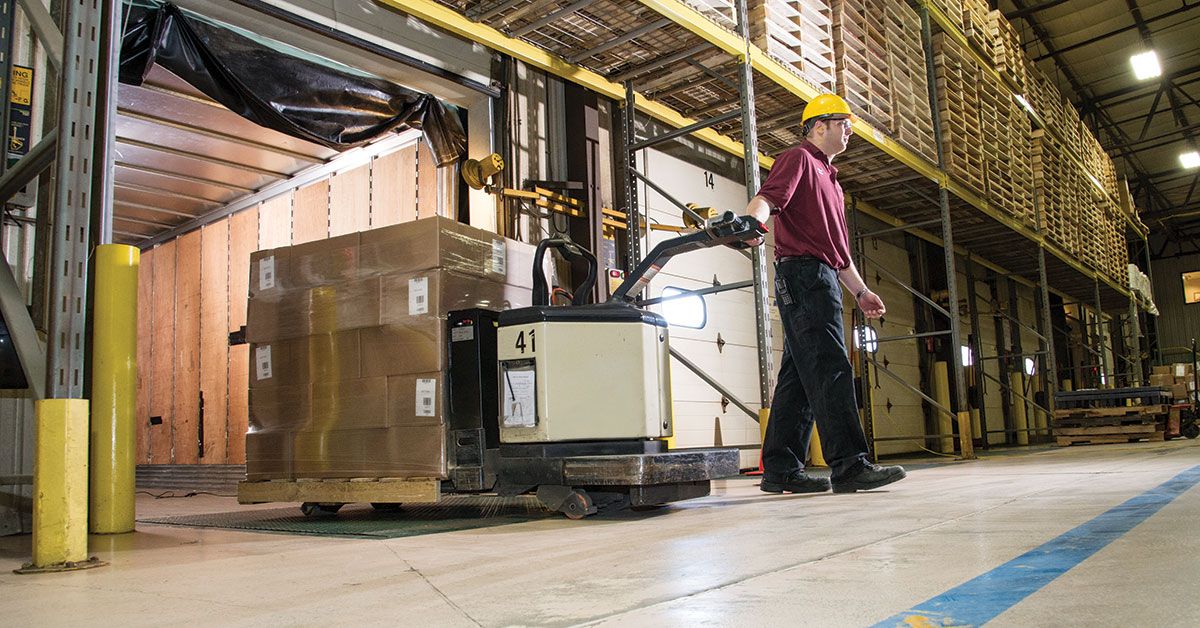
When we talk about powered industrial trucks (PITs), forklifts and order pickers generally dominate the conversation. But there’s another piece of equipment that deserves some attention: the powered pallet jack.
Powered pallet jacks are a type of PIT used to move pallets, often in tight spaces. They’re battery powered and are one of two designs: either walk-behind or ride-on. There are different types of pallet jacks as well, such as low lift or high lift.
While they may seem easy to use and harmless, pallet jacks are powerful, carry heavy loads, and if not operated and cared for properly, can cause injury and property damage. Just imagine a pallet jack rolling over someone’s foot. Not a good outcome. Or a rider being tossed from a walkie-rider pallet jack. Or what about when the operator accidentally hits the control, causing the pallet jack to lunge backward pinning him between the control arm and racking?
OSHA accident data from 2020 to 2024 show numerous incidents of hospitalization or amputation related to pallet jack operation—of both powered and manual equipment. Perhaps not surprisingly, many of the injuries were to the feet and legs as a result of the pallet jack running over the operator or pinning the operator against a fixed object resulting in amputation or fractured bones.
However, the greatest percentage of amputations involved the fingers and hands. Without adequate hand guards on the pallet jack’s handle, hands/fingers can be caught between objects such as racks, pallets, tables, and other equipment. Problems can be further magnified when other equipment is in use. For example, in one incident, an employee was loading a trailer when he caught his hand between the loaded pallet jack and a mobile cart. The employee amputated a fingertip and required hospitalization.
These and other hazards are why OSHA requires, in 1910.178(l), that operators of powered pallet jacks be trained, evaluated, and certified. And, just like a forklift operator, pallet jack operators must be re-evaluated at least once every three years.
In addition, pallet jacks must be inspected prior to use each shift, looking at such things as the forks, tires, backrest, hand guard, control arm, belly button switch, battery and cables, controls, brakes, and horn.
How Safety Management Suite Can Help

Got questions about pallet jacks or another workplace safety topic? Our Expert Help tool, conveniently linked from the homepage dashboard of the J. J. Keller® SAFETY MANAGEMENT SUITE, gives you direct access to our trusted team of in-house experts — acknowledged leaders in the safety, regulatory, and compliance fields — who are standing by to help answer your toughest compliance questions.
E-mail Newsletter
Sign up to receive the weekly EHS Insider email newsletter for safety articles, news headlines, regulatory alerts, industry events, webcasts, and more.