Do you know who’s qualified to conduct safety training?
Date Posted: 04/02/2026
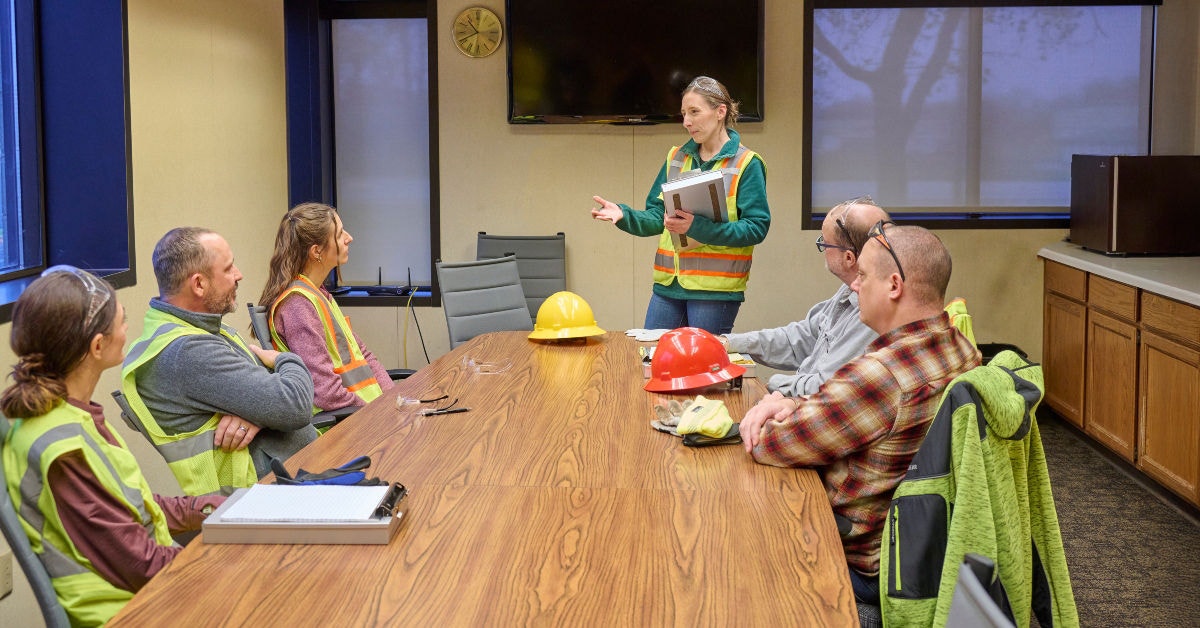
While more than 70 general industry regulations (29 CFR 1910) have training or information requirements, fewer than 10 have trainer requirements! Even in these instances, there’s leeway for you to determine who’s qualified to provide training. This may be someone within your organization or a third party. The trainer should be familiar with the information to be presented and how it applies to your workplace. Training must be understandable to all employees, and they must have the opportunity to ask questions.
1910 Subpart D, Walking-working surfaces
Workers who use personal fall protection and work in other specified high hazard situations must be trained about fall and equipment hazards, including fall protection systems they’ll use. A qualified person must train these workers to correctly identify and minimize fall hazards; use personal fall protection systems and rope descent systems; and maintain, inspect, and store equipment or systems used for fall protection.
Qualified person is defined at 1910.21(b) as “a person who, by possession of a recognized degree, certificate, or professional standing, or who by extensive knowledge, training, and experience has successfully demonstrated the ability to solve or resolve problems relating to the subject matter, the work, or the project.”
1910 Subpart F, Powered platforms, manlifts, and vehicle-mounted work platforms
These regulations cover powered platforms attached to buildings for maintenance purposes. Training must be conducted by a competent person. This is defined in 1910.66(d) as someone, “who, because of training and experience, is capable of identifying hazardous or dangerous conditions in powered platform installations and of training employees to identify such conditions.”
1910.120, Hazardous Waste Operations and Emergency Response (HAZWOPER)
The HAZWOPER standard goes over trainer qualifications at paragraphs (e)(5), (p)(7)(iii), and (q)(7). While the three paragraphs are not worded identically, all three call for trainers to either:
- Have satisfactorily completed a training course for teaching the subjects they are expected to teach, or
- Have the academic credentials and instructional experience necessary to demonstrate competent instructional skills and a good command of the subject matter they are to teach.
Under paragraph (e)(5), the trainer must also demonstrate competent instructional skills and knowledge of the subject matter if qualification method (1) above is used. Under paragraph (q)(7), “training” may qualify in lieu of academic credentials. The subjects that trainers must be able to convey to trainees are summarized in paragraphs (e), (p), and (q), depending on the operation.
1910.178, Powered industrial trucks
“All operator training and evaluation shall be conducted by persons who have the knowledge, training, and experience to train powered industrial truck operators and evaluate their competence.” OSHA says the necessary qualification can be obtained in a variety of ways:
- Through years of operating a powered industrial truck (PIT) and knowledge of safe practices and OSHA regulations pertaining to the operation,
- Going to a “train-the-trainer” or similar course, and/or
- Some combination of experience and training.
The only specific criteria OSHA lays out is found in a 2003 letter of interpretation. It says that trainers must have at some point operated the type of equipment they are training potential operators on, so that they can provide adequate instruction to trainees on how the equipment works, feels, etc.
1910.266, Logging operations
Training under this standard must be conducted by a “designated person,” which is defined as “an employee who has the requisite knowledge, training and experience to perform specific duties.”
1910.1030, Bloodborne pathogens
OSHA says, “The person conducting the training shall be knowledgeable in the subject matter covered by the elements contained in the training program as it relates to the workplace that the training will address.” The trainer could be a healthcare professional or non-healthcare professional, such as an industrial hygienist, provided that person understands the requirements of 1910.1030 and how it applies to the workplace.
How Safety Management Suite Can Help

Training plays a critical role in keeping workers safe. The Training area of the J. J. Keller® SAFETY MANAGEMENT SUITE contains online and classroom modules on a variety of topics and provides supplementary resources you can use to enhance your training program, including quizzes, handouts, and five-minute talks.
E-mail Newsletter
Sign up to receive the weekly EHS Insider email newsletter for safety articles, news headlines, regulatory alerts, industry events, webcasts, and more.