-

-
Chemical Management
J. J. Keller® SAFETY MANAGEMENT SUITE's Chemical Management tools help protect your team from hazardous chemicals in the workplace. From SDS access and GHS label generation to written program templates and employee training resources, it supports every major element of a compliant Hazard Communication program. Try J. J. Keller® SAFETY MANAGEMENT SUITE free for 30 days.
Enhance Safety With Superior Chemical Management
-
-
Expansive Safety Data Sheet Library
Search multi-language SDSs (by product/manufacturer name, CAS RN, and/or UN number), immediately preview or download, and add to your chemical product list.
-

-
Easy-to-Manage Product List
Create and maintain your chemical product inventory. Link to product SDSs, track usage by location and work area for recordkeeping, and more.
-
-
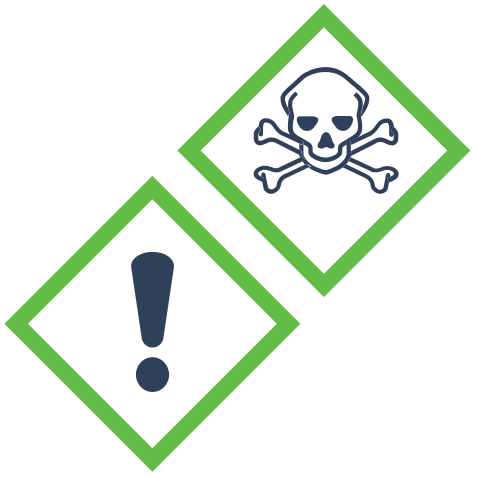
Convenient HazCom Label Generator
Easily generate and print GHS-compliant labels for chemicals on your product list.
-

-
Streamlined Employee Access
Put vital chemical information in the hands of those who need it. Share SDSs directly with employees who work with and around specific chemicals on the job.
-

-
Written Program Templates
Use customizable HazCom program templates for general industry and construction to document labeling, SDSs, chemical inventories, and training procedures.
-

-
Flexible HazCom Training Resources
Deliver essential HazCom employee training in various formats and languages to support understanding of GHS labels, SDSs, and key HazCom concepts.
TAKE THE HASSLE OUT OF HAZCOM COMPLIANCE!
- GET FREE SDSs
Comprehensive SDS Library
"Safety Management Suite is a low cost option that encompassed all our safety needs. Love the chemical library!"
Keith Fitzsimmons
Corporate EHS Manager
HO Penn Machinery Company
New York
SAFETY MANAGEMENT SUITE’S MOST POPULAR HAZCOM TRAINING TOPICS INCLUDE:

HAZCOM & SAFETY DATA SHEETS FAQS
Chemical hazards in the workplace are substances that can cause physical or health harm, as defined by the Hazard Communication (HazCom) standard. These hazards include any chemical that presents a risk to employee safety or health.
Employees may encounter chemical hazards in various forms, including:
- Liquids
- Solids
- Gases
- Vapors
- Fumes
- Mists
Understanding these different forms helps identify and manage potential exposure risks in the workplace.
The purpose of a hazard communication program is to ensure that employees understand the health and physical hazards of chemicals they may be exposed to, along with the protective measures they need to follow. It is designed to communicate critical safety information clearly and effectively.
Under OSHA’s Hazard Communication Standard (HCS or HazCom), this program ensures that information about chemical hazards (such as irritation, sensitization, carcinogenicity, flammability, corrosion, and reactivity) is properly shared with employees so they can work safely and reduce exposure risks.
GHS, or the Globally Harmonized System of Classification and Labeling of Chemicals, is a standardized system for classifying chemical hazards and communicating them through labels and Safety Data Sheets. It establishes consistent criteria for identifying both health and physical hazards.
GHS provides a single, harmonized approach to:
- Classifying chemicals based on their hazards
- Communicating those hazards through labeling and safety data sheets
In 2012, OSHA updated its Hazard Communication Standard (HCS or HazCom) to align with GHS, ensuring a more consistent and uniform system for chemical hazard communication.
A Safety Data Sheet (SDS) is a detailed document that provides essential information about a hazardous chemical, including its hazards, safe handling, storage, and disposal requirements. It helps employers and workers understand risks and implement appropriate protective measures.
An SDS, previously called a Material Safety Data Sheet (MSDS), is prepared according to paragraph (g) of 29 CFR 1910.1200. It typically includes information such as:
- What the chemical looks and smells like
- The hazards it presents
- How to store it safely
- How to dispose of it properly
This information supports safe use of chemicals and helps protect workers from health and physical hazards.
Yes, Safety Data Sheets (SDSs) are required if employees work with hazardous chemicals, except for household chemicals used in the same way as typical consumer use. SDSs must be accessible to employees as part of the hazard communication program.
Employers must ensure that SDSs are:
- Maintained for all applicable hazardous chemicals
- Readily available to employees
This requirement is part of ensuring workers can access important information about chemical hazards and safe handling practices.
Safety Data Sheets (SDSs) must be updated whenever there is a change to the chemical. Manufacturers or importers are responsible for keeping SDSs current and ensuring updated versions are provided with shipments.
Under the Hazard Communication (HazCom) regulations:
- An SDS must be included with the initial shipment of a chemical
- An updated SDS must be provided with the first shipment after any changes are made
This ensures employers and employees always have the most accurate and up-to-date safety information for each chemical.