


Give employees the knowledge and confidence to stay safe with J. J. Keller® SAFETY MANAGEMENT SUITE's extensive training options. Choose from hundreds of online courses, streaming videos, and classroom programs, along with thousands of supplemental resources. Try J. J. Keller® SAFETY MANAGEMENT SUITE free for 30 days.
Empower Your Team With Expert Safety Training
-

-
Backed By Industry Leaders
Rely on 30+ years of training experience to give your team trusted, up-to-date content that helps them stay safe and compliant.
-

-
Self-Paced Online Learning
Supplement classroom or field training with interactive, self-paced courses. Learners can train anytime through an online portal or our free mobile app — with multilingual options to support every team member.
-

-
Engaging Video Programs
Use on-demand videos to train teams on safety, HR, and compliance. Great for remote workers or group sessions on any schedule.
-

-
Customizable Classroom Training
Lead in-person sessions with ready-to-use materials like guides, quizzes, and certificates. Customize content to fit your workplace.
-

-
Ready-to-Use Training Tools
Access thousands of training resources like safety talks, presentations, quizzes, and handouts to make training more engaging and effective.
-

-
Simplified Training Management
Track attendance, scores, and records from one dashboard. Easily schedule classroom events and manage your training program.
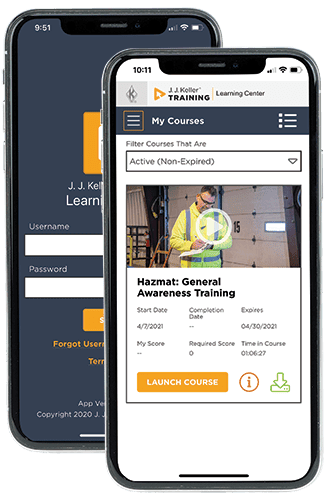
SIMPLIFY REQUIRED TRAINING WITH THE FREE J. J. KELLER® TRAINING APP FOR LEARNERS
Your learners that are enrolled in online training through the J. J. Keller® SAFETY MANAGEMENT SUITE can access and complete their assigned courses 24/7 with the FREE mobile app!
- Offline Viewing
Learners can download their assigned courses directly to their mobile device(s) and access them at any time - even without an internet connection. - Easy Tracking
Learners can filter courses by the due date and status to easily manage upcoming deadlines. - Mobile Compatibility
The J. J. Keller® Training Learning Center is compatible with both iOS and Android.


ELEVATE YOUR OSHA SAFETY TRAINING TODAY!
- START TRAINING FOR FREE
Training Materials Are Up-To-Date and Relevant
"We subscribe and use Safety Management Suite primarily for access to the library of training materials. We want to provide current, topical training to our team members and we like to change our training content every couple of years so things don't get stale - the materials that J. J. Keller provides meet these needs."
Kurt Kirkland
Regional EHS Manager - East
Tosca Services, LLC
SAFETY MANAGEMENT SUITE’S MOST POPULAR TRAINING TOPICS INCLUDE:

SAFETY TRAINING FAQs
Safety training is important because it helps reduce workplace injuries and illnesses by ensuring employees understand hazards and how to protect themselves. Providing clear instruction equips workers with the knowledge they need to perform their jobs safely.
According to data from the Bureau of Labor Statistics (BLS), approximately 2.8 million nonfatal workplace injuries and illnesses occur annually in private industry. Many of these incidents can be prevented when workers are given:
- Complete information about the processes they perform
- Awareness of the hazards they face
- Guidance on the equipment they use
- Understanding of available protections
- Knowledge of potential effects from chemical exposure
Effective training supports safer work practices and helps prevent avoidable incidents.
Some OSHA safety training is mandatory, but the specific requirements depend on an employee’s job duties. Employers must provide training when it is required by applicable OSHA standards for the tasks employees perform.
OSHA has mandated training for certain topics, including:
- Hazard communication (HazCom)
- Lockout/tagout
- Bloodborne pathogens
- Forklift operators
In addition to required training, many employers choose to provide extra safety training to further protect employees and reduce workplace risks.
OSHA training frequency depends on the specific standard that applies, but employees must always be trained before they are exposed to a hazard. Additional training may be required on a recurring basis or when conditions change.
While requirements vary by regulation, common expectations include:
- Initial training: Must be completed before employees are exposed to a hazard
- Refresher training: May be required periodically, when workplace conditions change, or if an employee is not performing tasks safely
Employers should review each applicable OSHA rule to determine the exact training and retraining requirements.
Yes, OSHA accepts online training as part of a safety and health training program, as long as it meets certain conditions. The training must include opportunities for interaction with a qualified trainer and provide enough hands-on experience for employees.
Computer-based training programs can be used to satisfy OSHA requirements if they:
- Allow trainees to ask questions and get answers from a qualified trainer
- Include sufficient hands-on or practical experience
These elements help ensure employees fully understand the material and can apply it safely in the workplace.
There is no single OSHA requirement that sets a standard retention period for all training records. Recordkeeping requirements, including how long records must be kept, are defined within each specific OSHA regulation.
In many cases:
- OSHA requires employers to maintain training records
- The regulation may not specify a retention timeframe
Employers should review each applicable OSHA standard to determine whether training records are required and how long they must be retained.