Addressing machine hazards: Common questions answered
Date Posted: 05/29/2026
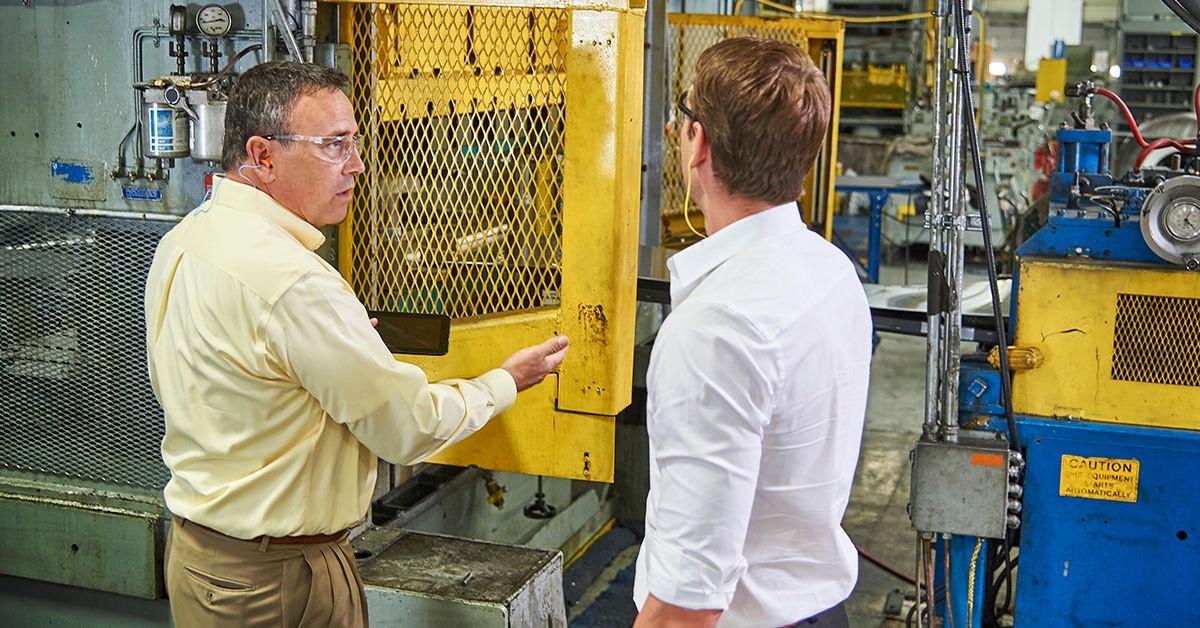
When workers operate or work around machinery, employers are often faced with practical safety questions that aren’t directly addressed in OSHA’s regulations. Common issues such as loose clothing, long hair, guard openings, and control devices like foot pedals are not always covered by the regulatory text. The following questions and answers clarify what OSHA requires when protecting workers from common machine-related hazards.
Can we prohibit loose clothing, long hair, or jewelry for workers operating machinery?
OSHA doesn’t specifically address this in its machine guarding regulation (29 CFR 1910.212). However, agency guidance clearly recognizes these items as hazards around moving machinery:
- Safeguarding Equipment and Protecting Workers from Amputations (OSHA 3170) advises employers to instruct workers not to wear gloves, jewelry, or loose-fitting clothing when operating grinding machines and to secure long hair.
- OSHA’s woodworking eTool similarly states, “Do not allow workers to wear loose clothing or long hair. Loose clothing or long hair can be easily caught up in rotating parts.”
Employers are expected to address recognized hazards in their workplace. As a result, many employers adopt policies restricting loose clothing, long hair, or jewelry when working near machinery. OSHA may issue citations under the General Duty Clause (Section 5(a)(1) of the OSH Act) or the machine guarding standard if workers are exposed to entanglement hazards.
Is there a maximum opening size before a machine guard is required?
OSHA’s machine guarding standard doesn’t specify a maximum opening size before a guard is required. Instead, it requires that the guard be “in conformity with any appropriate standards” and designed and constructed to prevent operators from having any part of their body in the danger zone during the operating cycle.
OSHA refers to the following “appropriate standards”:
- ANSI B11.0, Safety of Machinery
- ANSI B11.19, Performance Requirements for Risk Reduction Measures: Safeguarding and other Means of Reducing Risk
- NFPA 79, Electrical Standards for Industrial Machinery
Additionally, there are several machine-specific ANSI B11 series standards. These standards provide detailed guidance on guard openings, reach distances, and risk reduction methods.
Must foot pedals used to operate machinery be guarded or have a cover?
If unintentionally pressing on a foot pedal exposes workers to a hazard, OSHA expects employers to implement protective measures, such as guarding or covering the pedal. Although there are no foot pedal requirements in OSHA’s machine guarding standard, its Mechanical Power Presses standard (29 CFR 1910.217) offers some, such as:
- The pedal must be protected against accidental operation (e.g., from falling objects or unintended contact).
- The pedal must have a nonslip contact surface.
- Return springs must be designed to prevent failure.
- Counterweights must have enclosed travel paths.
How Safety Management Suite Can Help

Even in situations where OSHA does not provide detailed regulatory requirements, recognized hazards like entanglement or unintended machine activation must still be controlled. If you have questions about machine guarding or another topic, we can help! The Expert Help tool is conveniently linked from the homepage dashboard of the J. J. Keller® SAFETY MANAGEMENT SUITE. It gives you direct access to our trusted team of in-house experts — acknowledged leaders in the safety, regulatory, and compliance fields — who are standing by to help answer your toughest compliance questions.
E-mail Newsletter
Sign up to receive the weekly EHS Insider email newsletter for safety articles, news headlines, regulatory alerts, industry events, webcasts, and more.