Safety data sheets: Your top questions answered
Date Posted: 04/10/2026
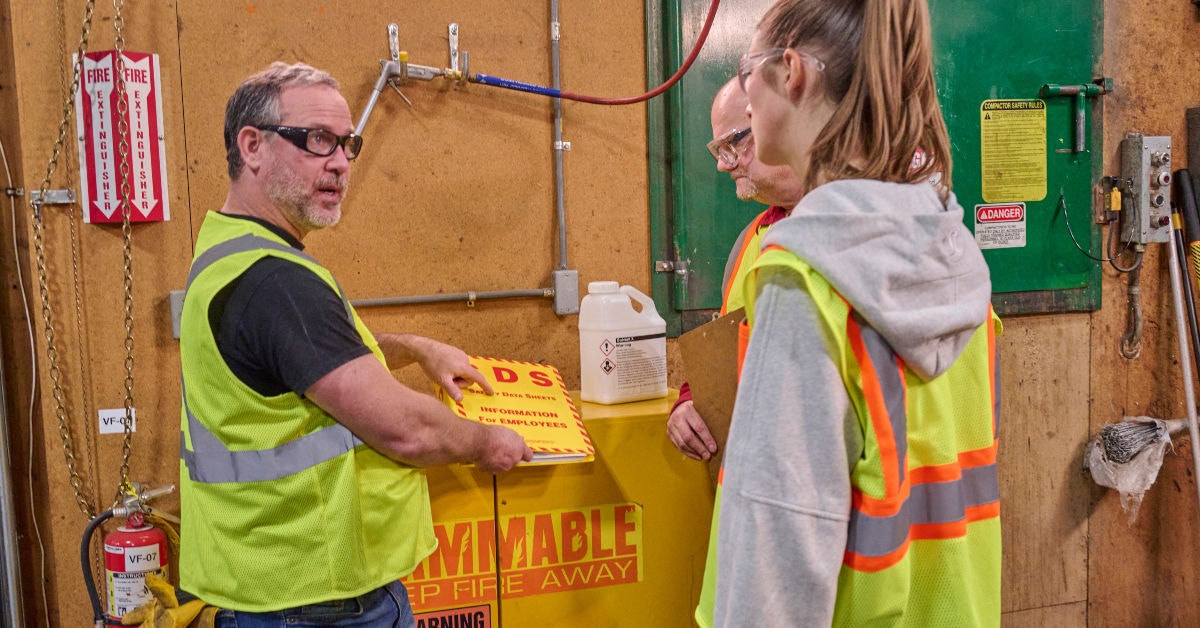
Safety data sheets (SDSs) are a key part of managing chemical safety in the workplace. They provide information on chemical hazards, safe handling and storage practices, required protective equipment, and more. SDSs help you protect employees and meet some of OSHA’s Hazard Communication (HazCom) requirements. Following are the top SDS questions we receive from customers.
Can we store SDSs electronically?
You can store SDSs on a company website or with an off-site/web-based SDS service provider. You must not require employees to perform an internet search. Employees must be trained to use the system, and you must have a backup system in place in case the main system goes down. This includes such options as a physical binder, a dedicated folder on a local server, or specialized SDS management software.
Do we have to keep SDSs for chemicals that we no longer use?
Even after a chemical is no longer used, OSHA’s Access to employee exposure and medical records standard at 1910.1020 requires you keep either the SDS or a record of the chemical name, where it was used, and when it was used. This information must be retained for at least 30 years. The idea is that if there’s ever a health concern down the road, there’s a paper trail showing what employees may have been exposed to.
What does “readily accessible” mean?
OSHA says that SDSs must be readily accessible to employees during each work shift when they are in their work area. There’s no “distance” requirement, but employees must know the location of SDSs and there must be no barrier to employee access, such as having to ask a supervisor for an SDS or keeping the SDSs in a locked cabinet. If SDSs are kept electronically, employees must be trained to use the system.
Do we need an SDS for consumer products?
It depends. In OSHA’s guidance for its inspectors, the agency specifies the following questions be considered when determining whether a consumer product is covered by the HazCom standard:
- What is the duration of use of the product, i.e., for what period of time did the employees use the chemical during the workshift and workweek? Did it greatly exceed normal or expected use by a consumer?
- Was the frequency of employee use significantly greater than that of a normal consumer?
- A product would not be covered by the HazCom standard if a worker chooses to clean their personal workspace with a product that’s meant for cleaning purposes.
- A product would be covered by the HazCom standard if a worker’s job duty includes custodial work such as cleaning desks, offices, and bathrooms.
- How was the product used and in what amounts? Was the product used in the workplace for the purpose intended by the manufacturer?
You may have some consumer products that are covered by HazCom and some that aren’t, depending on the frequency and duration of their use, and whether they’re used in the manner intended by the manufacturer.
How Safety Management Suite Can Help

The Chemical Management feature in the J. J. Keller SAFETY MANAGEMENT SUITE® can help you manage the covered hazardous chemicals in your workplace. You can develop and maintain your chemical inventory, search our database for SDSs (or upload your own), and create electronic SDS binders.
E-mail Newsletter
Sign up to receive the weekly EHS Insider email newsletter for safety articles, news headlines, regulatory alerts, industry events, webcasts, and more.