Developing a sound hearing conservation program
Date Posted: 05/08/2026
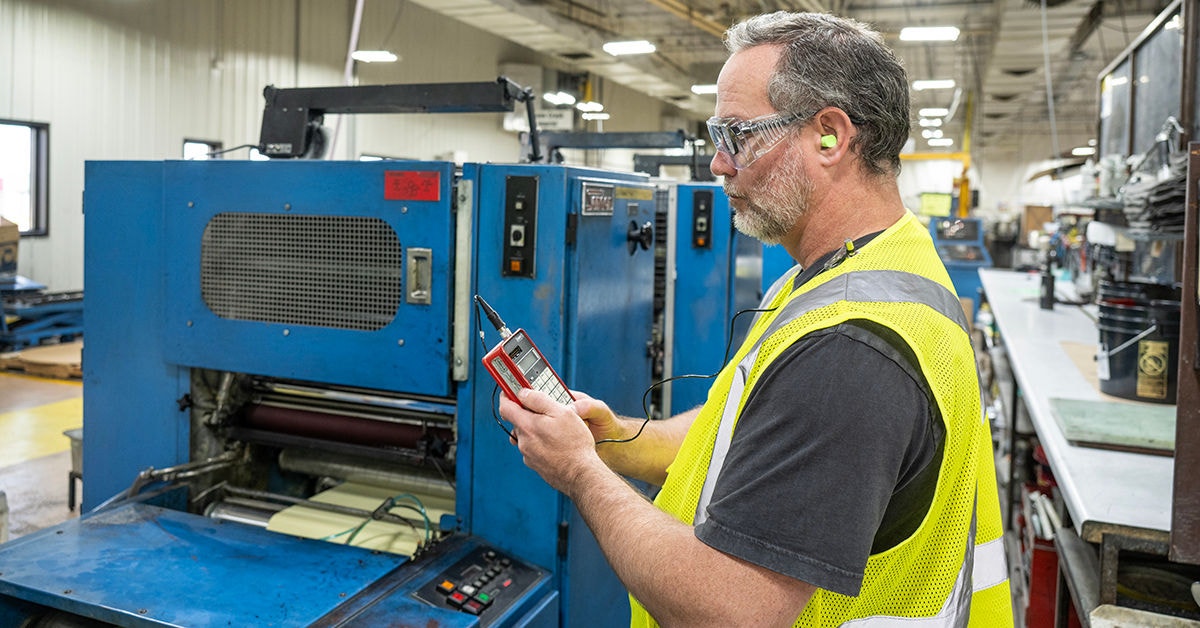
OSHA requires employers to determine if workers are exposed to excessive noise in the workplace. If noise levels are too high, employers must use feasible engineering or administrative controls to eliminate or reduce exposure. Where these controls are not sufficient, an effective hearing conservation program must be implemented. This includes:
- noise monitoring,
- hearing tests,
- hearing protection devices,
- an annual training program, and
- recordkeeping.
Noise monitoring
Noise exposure levels must be measured in a way that accurately identifies employees exposed to noise at or above 85 decibels (dB) averaged over 8 working hours, or an 8-hour time-weighted average (TWA). The exposure measurement must include all continuous, intermittent, and impulsive noise within an 80 dB to 130 dB range and must be taken during a typical work situation. Monitoring is commonly conducted using sound level meters and dosimeters worn by employees. Employees must be able to observe the monitoring and those who are exposed at or above an 8-hour TWA of 85 dB must be given the results.
Monitoring must be repeated whenever changes in production, process, or controls increase noise exposure. These changes may mean that more employees need to be included in the program or that their hearing protectors may no longer provide adequate protection.
Hearing tests
Affected employees must be provided with hearing tests (audiograms) in order to monitor any changes in their hearing and to know if the hearing conservation program is effective. A baseline audiogram must be provided either prior to beginning work with the company or changing jobs to one affected by the hearing conservation requirement. This is followed up with annual audiograms. If tests show the employee has evidence of a standard threshold shift (STS) relative to the baseline audiogram, additional testing or examinations may be necessary.
Hearing protection devices (HPDs)
HPDs must be available at no cost to any employee exposed at or above an 8-hour TWA of 85 dB and are required for employees who are exposed to an 8-hour TWA exceeding 90 dB. Employees must be able to select HPDs from a variety of suitable choices.
Training
Annual training must be provided on:
- The effects of noise on hearing;
- The purpose, advantages, and disadvantages of various types of hearing protectors;
- The selection, fit, use, and care of protectors; and
- The purpose and procedures of audiometric testing.
Information provided in the training program must be updated to be consistent with changes in protective equipment and work processes.
Recordkeeping
Noise exposure measurement records must be kept for two years, and audiometric test results must be maintained for the duration of the affected employee’s employment. Audiometric test records must include the employee’s name and job classification, date, examiner’s name, date of the last acoustic or exhaustive calibration, measurements of the background sound pressure levels in audiometric test rooms, and the employee’s most recent noise exposure measurement.
How Safety Management Suite Can Help

Regulations form the backbone of your compliance responsibilities — but they don’t always provide clear answers. That’s where the Reference Hub in the J. J. Keller® SAFETY MANAGEMENT SUITE comes in. We’ve organized supplemental guidance by topic, making it easy to find what you need. For example, the Hearing Protection topic includes 40 OSHA LOIs, FAQs like how to handle employee refusals for hearing tests, and other practical insights to support confident decision-making.
E-mail Newsletter
Sign up to receive the weekly EHS Insider email newsletter for safety articles, news headlines, regulatory alerts, industry events, webcasts, and more.