Bonding and grounding when dispensing flammable liquids
Date Posted: 05/21/2026
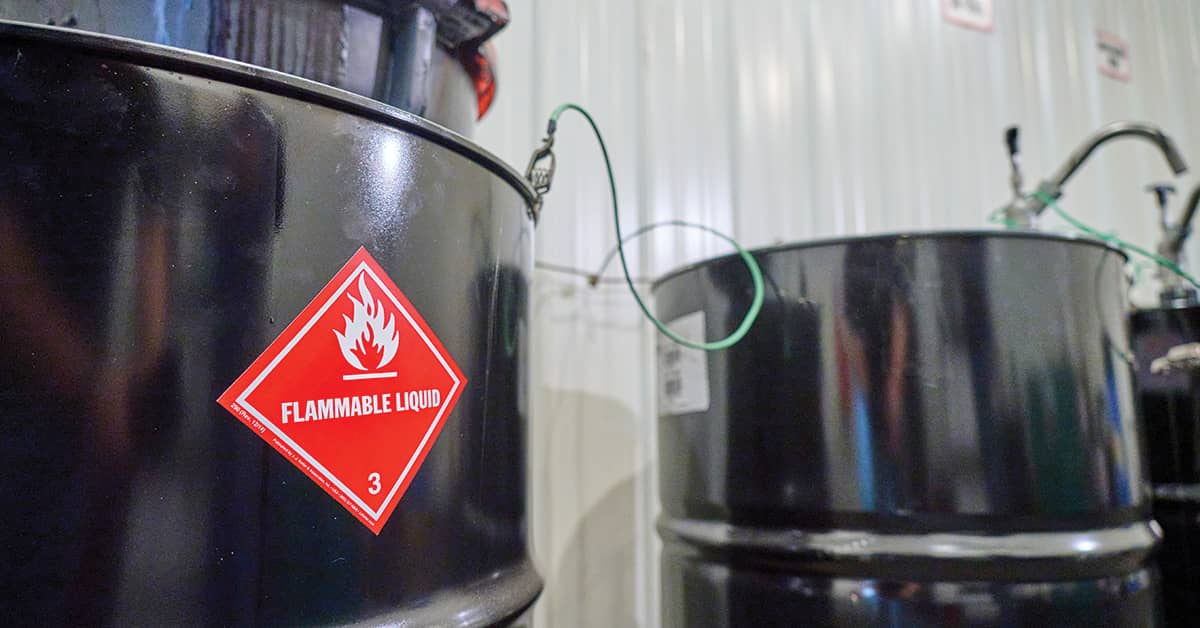
All containers of Category 1, 2, or 3 liquids (with a flashpoint lower than 100°F) need to be bonded and grounded during dispensing. This can include dispensing from or to non-metallic containers, even though the container material may not be recognized as conductive (for example, polyethylene and IBC-type containers).
Bonding and grounding two non-conductive containers might seem unnecessary since the materials are insulators and cannot conduct current. However, a static charge could still be generated by liquids flowing. A static spark could be capable of raising the vapor temperature above the flashpoint, causing an explosion. OSHA is concerned that any static charge between two containers be equalized, if not eliminated, so that no potential for a static discharge exists.
With non-metallic containers, employers could use a fill tube or grounding wire to achieve proper bonding. They could also use a metallic pump on the container and ground/bond the pump. Most modern plastic containers may have an embedded ground wire so it can be grounded/bonded as needed.
Requirements
The process of bonding and grounding can be defined as providing an electrically conductive pathway between a dispensing container, a receiving container, and an earth ground. This pathway helps eliminate the build-up of static electricity by allowing it to dissipate into the ground safely.
Both OSHA and the National Fire Protection Association (NFPA) have bonding and grounding requirements when transferring flammable liquids.
- NFPA 30, Flammable and Combustible Liquids Code, covers bonding and grounding. Note that OSHA adopted the 1969 version of NFPA 30.
- OSHA’s requirements are found in 1910.106, Flammable liquids. The regulation says that flammable liquids with a flashpoint below 100°F cannot be dispensed into containers unless the nozzle and container are electrically interconnected. OSHA discusses how bonding can be achieved using a metallic floorplate
Grounding cabinets
OSHA and NFPA don’t require that the cabinet be grounded automatically by default. However, most manufacturers provide a place on the flammable cabinet to ground it properly. If workers are dispensing flammable liquids while the container is inside the cabinet, it should be grounded using the manufacturer’s approved grounding point.
How Safety Management Suite Can Help

Flammable liquid storage requirements can be confusing and time-consuming, with limited OSHA regulations but no shortage of real-world challenges. Stop struggling and join our compliance experts in an upcoming webinar Flammable Liquid Logic: Regulatory Review and Best Practices for Fireproofing Your Facility, on Thursday, May 28, at 1:00 PM CDT. They’ll provide an in-depth discussion of common flammable liquid storage issues affecting General Industry and Construction workplaces alike. We’ll save time at the end of the webcast for your questions.
E-mail Newsletter
Sign up to receive the weekly EHS Insider email newsletter for safety articles, news headlines, regulatory alerts, industry events, webcasts, and more.