Fewer than 100 employees? Take a look at OSHA’s non-construction Top 10
Date Posted: 02/09/2026
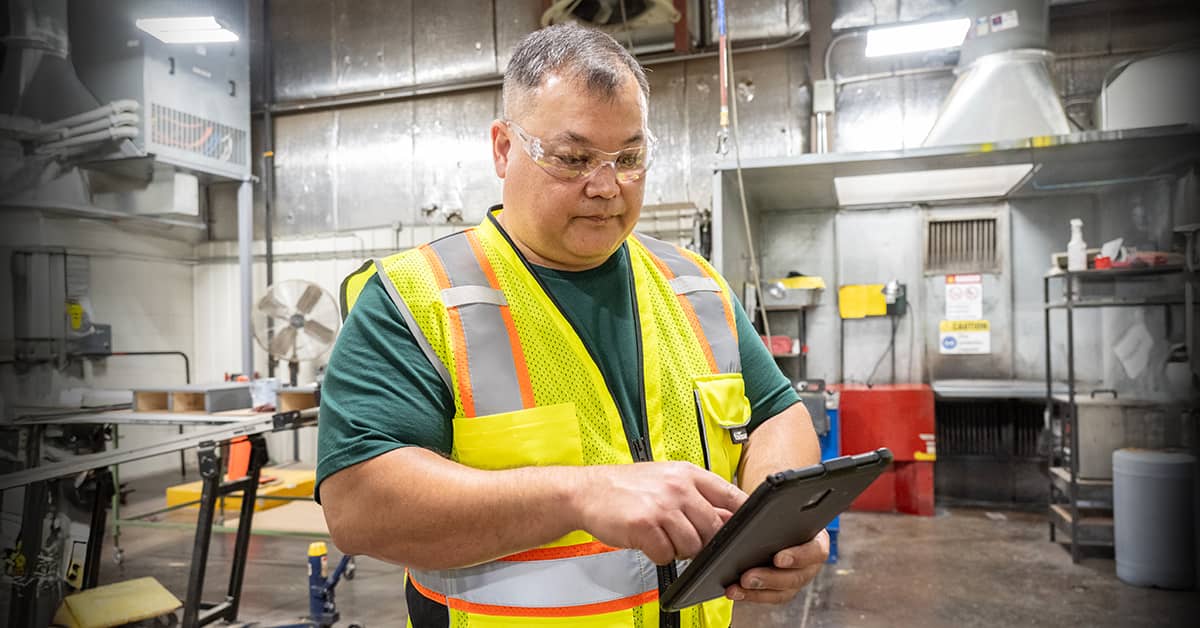
Each year, OSHA identifies recurring violations that put employees’ safety at risk. While these violations can lead to costly penalties, they also highlight gaps in training, compliance, and safety culture. Our table shows the top 10 non-construction violations for employers with fewer than 100 employees as well as the top three violators for each.
Standard #
Top 3 violators
Rank
1
Standard #
1910.1200 – Hazard communication
Top 3 violators
- Fabricated metal product manufacturing
- Repair and maintenance
- Nonmetallic mineral product manufacturing
Rank
2
Standard #
1910.134 – Respiratory protection
Top 3 violators
- Fabricated metal product manufacturing
- Nonmetallic mineral product manufacturing
- Repair and maintenance
Rank
3
Standard #
1910.178 – Powered industrial trucks
Top 3 violators
- Fabricated metal product manufacturing
- Warehousing and storage
- Merchant wholesalers, durable goods
Rank
4
Standard #
1910.147 – The control of hazardous energy (lockout/tagout)
Top 3 violators
- Fabricated metal product manufacturing
- Plastics and rubber products manufacturing
- Food manufacturing
Rank
5
Standard #
1910.212 – Machine guarding
Top 3 violators
- Fabricated metal product manufacturing
- Plastics and rubber products manufacturing
- Machinery manufacturing
Rank
6
Standard #
1903.19 – Abatement verification
Top 3 violators
- Wood product manufacturing
- Nonmetallic mineral product manufacturing
- Fabricated metal product manufacturing
Rank
7
Standard #
1910.303 – Electrical – general
Top 3 violators
- Fabricated metal product manufacturing
- Warehousing and storage
- Food manufacturing
Rank
8
Standard #
1910.132 – Personal protective equipment (PPE) – general requirements
Top 3 violators
- Fabricated metal product manufacturing
- Administrative and support services
- Merchant wholesalers, durable goods
Rank
9
Standard #
1910.305 – Electrical – Wiring methods, components, and equipment for general use
Top 3 violators
- Fabricated metal product manufacturing
- Food manufacturing
- Warehousing and storage
Rank
10
Standard #
Section 5(a) of OSH Act – General Duty Clause
Top 3 violators
- Administrative and support services
- Fabricated metal product manufacturing
- Warehousing and storage
* Data reflect October 2024 through September 2025
Breaking it down
Citations were heavily concentrated in manufacturing industries, perhaps not surprising as these environments can present a wide range of hazards such as chemicals, moving machinery and equipment, and temperature extremes. Rounding out the top violators were repair and maintenance, warehousing and storage, merchant wholesalers, and administrative and support services.
Administrative and support services, which includes things like employment services, travel services, and facilities support services, was found only in the PPE and General Duty Clause categories. Under the PPE standard, employers must perform a hazard assessment, document and certify the assessment, provide appropriate PPE, and train employees in its proper usage, among other requirements. OSHA can use the General Duty Clause to cite for hazards for which no regulatory standard exists, such as heat, ergonomics, and workplace violence.
Food manufacturers were dinged with lockout/tagout and electrical citations. Employees in this industry may perform equipment maintenance or otherwise be exposed to hazards during this maintenance; lockout/tagout covers these activities. Employees exposed to electric shock or who work on or near exposed energized parts must be trained according to 1910.332.
Number six on the list, abatement verification, was a surprise. Under 1903.19, “abatement” means action by an employer to comply with a cited standard or regulation or to eliminate a recognized hazard identified by OSHA during an inspection. OSHA sets a date for hazards to be corrected, and employers must certify and document that this has been done. They also may be required to submit an abatement plan and/or a progress report. Additionally, the employer must inform affected employees and their representative(s) about abatement activities by posting a copy of each document submitted to OSHA or a summary of the document near the place where the violation occurred.
How Safety Management Suite Can Help

Whether you’re looking for an overview of a safety topic or a word-for-word regulation, the Reference Hub in the J. J. Keller® SAFETY MANAGEMENT SUITE can help. Use the A-Z listing to choose the topic you’re interested in. Inside, you’ll find ezExplanations, federal OSHA regulations, state comparison tables, FAQs, letters of interpretation, and more.
E-mail Newsletter
Sign up to receive the weekly EHS Insider email newsletter for safety articles, news headlines, regulatory alerts, industry events, webcasts, and more.