Step up to safety with walking-working surface inspections
Date Posted: 12/08/2025
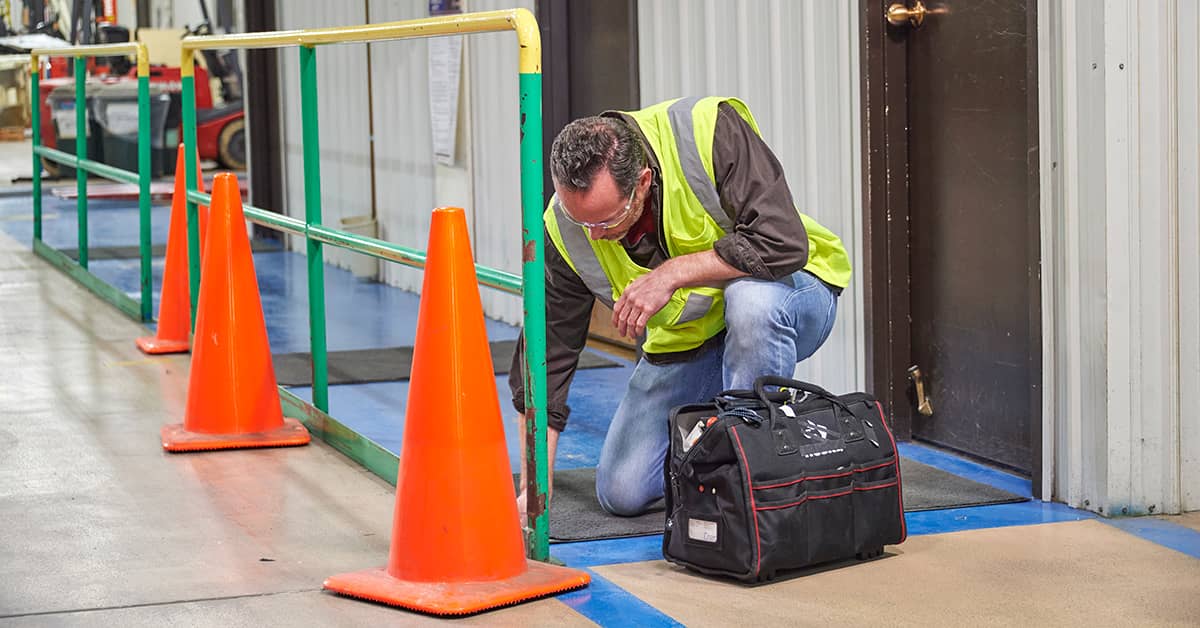
Falls on the same level are one of the most common workplace injuries and, according to the Liberty Mutual Safety Index, cost companies $10.5 billion annually. Even if there’s a firm, level working surface to walk on such as office floors or factory shop floors, employees can still be injured. Any damaged, cluttered, or wet walking surface can easily contribute to an injury.
Under OSHA’s Walking-Working Surfaces rule at 29 CFR 1910 Subpart D, all general industry employers must:
- Conduct hazard assessments to determine their workplace fall and falling object hazards;
- Inspect all walking-working surfaces for fall or falling object hazards on a regular basis; and
- Train and retrain their employees when necessary on fall protection systems and equipment.
Regular and “as necessary” inspections
Any surface employees walk on, work on, or use to gain access to an area in the workplace, must be inspected. Under 1910.22, these inspections must be done “regularly” and “as necessary” to ensure that they’re in safe condition for employee use.
“Regular inspection” means that an employer has some type of schedule, formal or informal, for inspecting walking-working surfaces that’s adequate to identify hazards. OSHA allows employers to determine when and how often these inspections are conducted. Once an employer makes this determination, inspections must be conducted according to that frequency.
“As necessary” inspections must be conducted when workplace conditions, circumstances, or events occur that warrant an additional check to ensure that walking-working surfaces are safe for employees use. Such inspections would not be conducted at fixed times because situations could arise at any time that put workers at risk of slips, trips, and falls.
Hazardous conditions on walking-working surfaces must be corrected or repaired before an employee uses the surface again. If the correction or repair can’t be made immediately, the hazard must be guarded to prevent employees from using the walking-working surface until the hazard is corrected or repaired. A qualified person must perform or supervise any correction or repair that involves the structural integrity of the walking-working surface. Under 1910.21, “qualified” is defined as “a person who, by possession of a recognized degree, certificate, or professional standing, or who by extensive knowledge, training, and experience has successfully demonstrated the ability to solve or resolve problems relating to the subject matter, the work, or the project.”
It's a best practice to maintain documentation for inspections, although it’s not required by the regulations. Documentation ensures that inspections are being done at the required frequency. It also:
- Serves as a record of the company’s compliance,
- Allows a company to trace the history of a hazard(s),
- Helps identify trends (i.e., leading indicators) that could result in non-compliance if not corrected, and
- Aids in post-accident investigations.
How Safety Management Suite Can Help

When you conduct walking-working surface inspections, you want to make sure you don’t overlook anything. Get started using the Audits feature in J. J. Keller® SAFETY MANAGEMENT SUITE. Here you’ll find ready-to-use checklists for various types of walking-working surfaces, including designated areas, dockboards, ladders, floors, stairways, and more.
E-mail Newsletter
Sign up to receive the weekly EHS Insider email newsletter for safety articles, news headlines, regulatory alerts, industry events, webcasts, and more.